In short
- It is a device brought to the stairs and driven by a trained companion; the person being carried does not use it alone.
- Two manufacturer manuals (2012 and 2018) give limits on step, width, landing, slope and weight, and require training and the ability to climb stairs backwards.
- The SAPA list has "Trepadores de Escadas Elétrico" (12 17 03), but we could not confirm it funds these devices or any condominium rule.
- We found only one dated price (a 2024 table, plus VAT) and no rental offer.
A “portable stair lift” is not fixed to the staircase. It is a device that is brought to the stairs and, driven by a companion, carries a person seated in a wheelchair up and down the steps. This guide explains what two manufacturer documents say, when this solution makes sense, what we know about public support and apartment-building rules, and what to ask a supplier.
Updated on 3 November 2026. General information, not a substitute for a qualified technician, the building administrator or the supplier.
The essentials
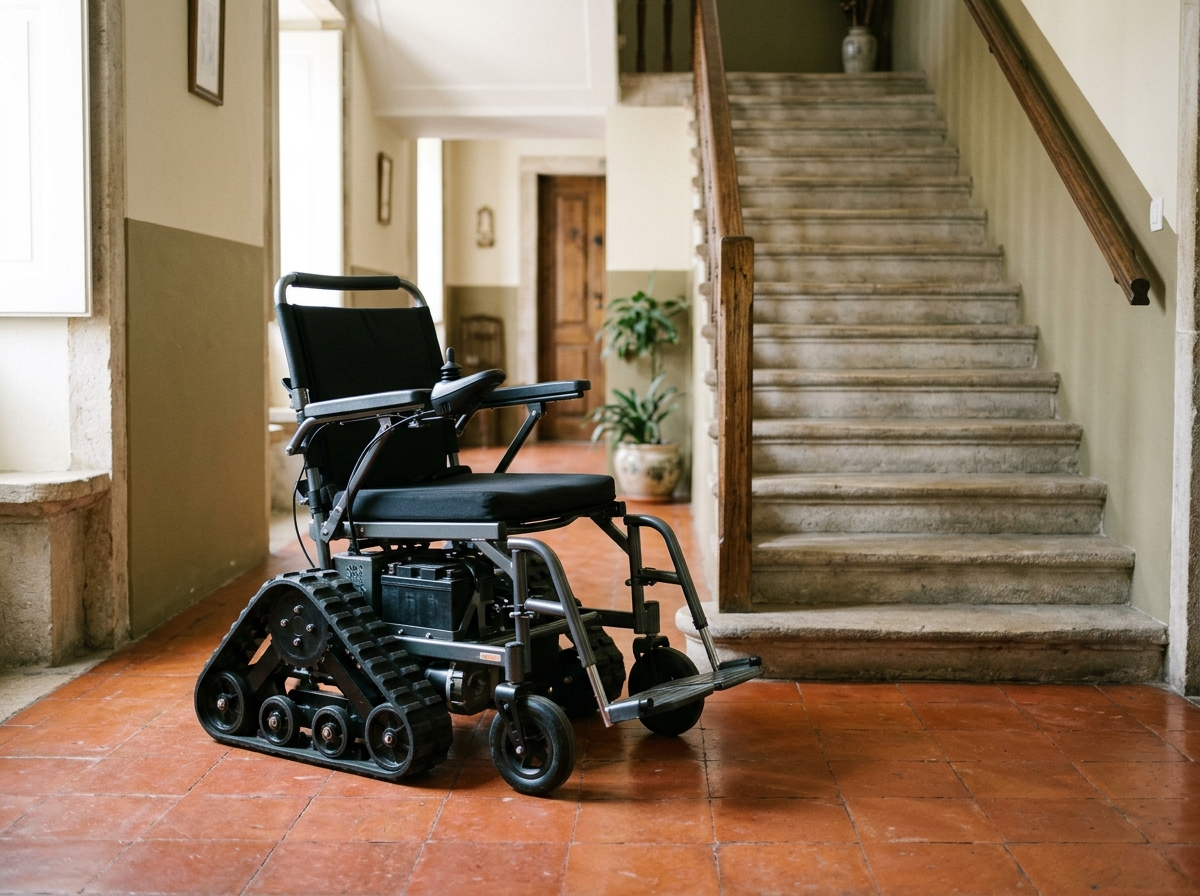
- The name comes from the market. The official list of assistive products calls it “Trepadores de Escadas Elétrico” (electric stair climbers). In the manuals we read two types: one with wheels, which attaches to the wheelchair, and one with tracks.
- The person driving it needs training. Both manuals require an instructed person who can climb stairs backwards. The person being carried cannot use it alone.
- No building works, but there are limits on step height, width, landing, slope and weight. One of the models only works on straight stairs.
- We found no clear public support and no condominium rule for this type of device.
- We found only one dated price, from a 2024 table. We found no rental.
What it is, and what it is not
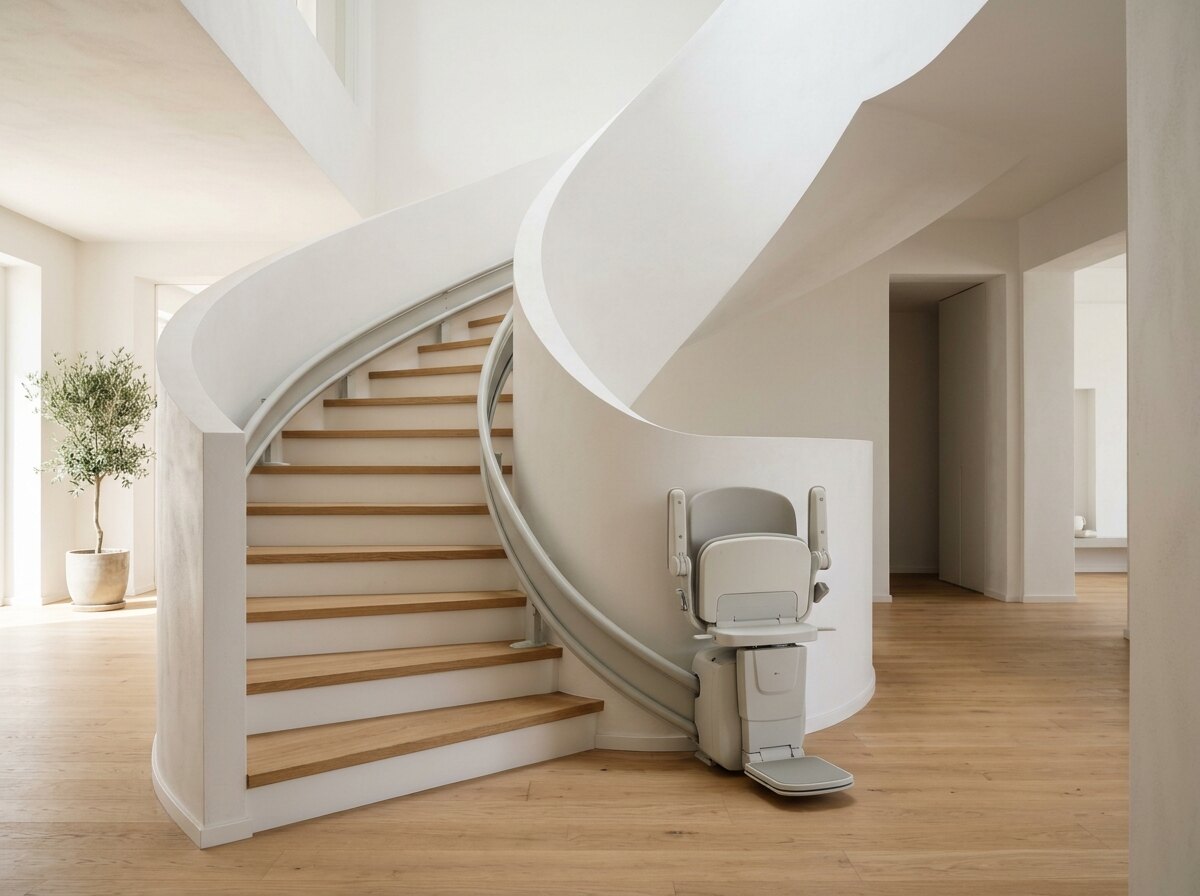
A stair lift chair has a fixed rail and the person can use it alone. The portable device has no rail: it is stored away and only goes to the stairs when needed, driven by another person.
The manuals describe two different models:
| Alber scalamobil (instructions in Portuguese, edition of 10.04.2012) | Sano Liftkar PTR (manual in English, 2018-08, Rev 04) | |
|---|---|---|
| Type | Wheeled; attaches to the wheelchair through two brackets fitted by the dealer | Tracked; the wheelchair is secured to the device |
| Stairs | Step height 11 to 20 cm (S35) or 14 to 25 cm (S38); minimum width 55 cm on straight stairs, depending on the wheelchair; minimum landing 1.35 m on U-shaped stairs | Straight stairs only; not for spiral stairs or tight turns; maximum slope 35°; minimum landing 970 × 970 mm |
| Load | Person up to 140 kg, “the technically possible upper limit” | 130 kg or 160 kg depending on the model, person and wheelchair together |
| Device weight | 23 kg (S38), 28 kg with the handle | 39 kg |
| Operator | Instructed, able to climb stairs backwards and to lift at least 20% of their own weight | With proof of training, able to climb stairs backwards; children may not use it |
Both manuals ask for dry stairs without wax, firmly fixed rugs, both hands always on the handle, and the carried person seated securely. These are only two models, with manuals from 2012 and 2018: always ask for the current manual.
Training and servicing
- Training. Alber says instruction is given by the dealer or the manufacturer, on a staircase going up and down, at no extra charge. Sano says the manual “does not replace” the obligatory training.
- Servicing. Alber asks for an inspection by an expert at least every two years. We read only what the manufacturer writes, not a legal rule.
- Second-hand. Sano asks for a safety check before the device is reused and proof of training for every operator. See also used or rented.
When it fits
No official source we read says who this device is for. The reading below is ours.
- It may make sense when trips are rare, the staircase is straight and wide, a trained person is always there, and a rail cannot or should not be installed, for example in a rented home.
- It fits poorly if the person is alone at home and needs to go up or down by themselves, if the stairs are curved or have small landings, if the use is daily, or if nobody can climb stairs backwards carrying the weight of the device and the chair.
To compare options, use the choice tool.
Apartment buildings, condominium rules and evacuation
The guide on stairs in apartment buildings explains the two Civil Code routes (a vote, or prior notice to the administrator). Both speak of “placing” lifting platforms. A device that is not installed is not clearly either of them and we found no rule about it. The prudent course is to notify the administrator in writing and read the building’s rules.
On evacuation, that guide says the width left with the equipment folded is what counts. A device stored at home does not reduce the shared staircase; while climbing it occupies the stairs, and Alber says it must not be left standing on them. This reading is ours: we found no fire-safety rule on portable devices.
Public support
In the SAPA list (Despacho no. 11077/2025, Annex I) three lines come close:
- 12 17 03, “Trepadores de Escadas Elétrico”: reusable, prescribed by a multidisciplinary team with a physiotherapist or occupational therapist and a physiatrist, funder ISS.
- 18 30 08, “Plataformas de elevação portáteis” (portable lifting platforms): the name does not say whether it includes stair climbers.
- 18 30 24, “Suportes para subir escadas sem assento ou plataforma” (supports for climbing stairs without a seat or platform).
The Invacare Portugal table gives the scalamobil ISO code 18 30 12, which is not in the Despacho list. We do not know under which code it would be prescribed. The Portuguese manual from Alber (2012) mentions devices “provided by Social Security”. How to apply is in who pays.
Price and availability
The only dated price we found is the recommended retail price table of Invacare Portugal II, Lda, valid from January 2024: 7,019.07 € for the scalamobil S38, plus VAT. It is one model, from one importer, two years ago: not a market price. The table asks that compatibility with the wheelchair and a demonstration on the staircase of use be validated. We found no rental offer. See comparing quotes.
What to ask a supplier
- The current manual, in Portuguese, and the declaration of conformity, with its date. The manuals cite Directives 93/42/EEC and 2006/42/EC. According to the European Commission, Regulation (EU) 2023/1230 applies on a mandatory basis from 20 January 2027. Ask which regime applies to the model on sale.
- Who gives the training, where, to how many people, and whether there is a written certificate.
- A test on your staircase and with your wheelchair. Give the measurements, as in how to measure the stairs.
- The limits: step, width, landing, slope, total load.
- Periodic servicing: who does it in Portugal, what it costs, and what happens to the warranty if it is missed.
- The final price, with VAT, training, delivery and servicing.
What we could not confirm
- The text of Regulation (EU) 2023/1230. EUR-Lex did not open for us. The date comes from the Commission’s page; we do not know whether these devices fall within the regulation’s scope.
- Whether SAPA funds these devices, and under which code.
- Whether any condominium or fire-safety rule covers portable devices.
- Whether servicing is legally mandatory. We saw only the manufacturer’s.
- Prices, rental and availability in Portugal, beyond the 2024 table.
- Whether the models in the manuals are still sold in the same versions.
Sources (read on 3 November 2026)
- Alber, scalamobil S35/S36/S38, Instruções de uso (PT), edition 10.04.2012, hosted by Invacare: chapters 1, 2, 10, 11, 12 and 13. https://www.invacare.eu.com/sites/eu/files/csv_migration/product_docs/technical_docs/DTEC001472_gebrauchsanweiosung_s35.pdf
- Sano, LIFTKAR PTR instruction manual, 2018-08, Rev 04: safety, technical data, re-use, declaration of conformity. https://cdn.shopify.com/s/files/1/0509/1783/4939/files/Sano-PTR-betjeningsvejledningENG.pdf
- Invacare Portugal II, Lda, Tabela PRP 2024 Scalamobil, valid from January 2024: https://www.medicalplus.pt/wp-content/uploads/2024/01/Tabela-PRP-2024-Scalamobil.pdf
- INR, Despacho no. 11077/2025, Diário da República, 2nd series, no. 181, 19-09-2025, Annex I (12 17 03, 18 30 05 to 18 30 24): https://files.diariodarepublica.pt/2s/2025/09/181000000/0008700121.pdf
- European Commission, “Machinery” page (application date of Regulation (EU) 2023/1230): https://single-market-economy.ec.europa.eu/sectors/mechanical-engineering/machinery_en
- Civil Code, Decree-Law no. 220/2008 and Portaria no. 135/2020: cited through the apartment-building guide, not re-read here.
Questions and answers
According to the Alber (2012) and Sano (2018) manuals, only a trained person who can climb stairs backwards and is in good physical condition. The person being carried does not drive it.
No. The manuals give limits. The Sano one works only on straight stairs up to 35°. The Alber one asks for steps of 11 to 20 cm (S35) or 14 to 25 cm (S38).
We could not confirm it. The SAPA list (Despacho no. 11077/2025) has "Trepadores de Escadas Elétrico" (12 17 03), reusable and funded by ISS, but prescription depends on a multidisciplinary team.
We found no rule on portable devices. The Civil Code speaks of placing lifting platforms. The prudent course is to notify the administrator in writing and read the building's rules.