In short
- The choice depends on the stairs, the person, the place (indoor or outdoor), the floors and whether the stairs are shared.
- EN 81-40:2020 covers stair lifts and platforms on stairs; EN 81-41:2024 covers vertical platforms without a fully enclosed carrier.
- Ask for the CE marking and the declaration of conformity with the serial number. Regulation (EU) 2023/1230 applies from 20 January 2027.
- The real decision is the technical visit. CE marking does not guarantee the model suits your stairs.
Straight chair, curved chair, outdoor chair, platform or lift: the name changes, the question stays the same. What suits this staircase and this person? This guide shows what decides the choice, which papers to ask the supplier for and which questions to put. It does not recommend brands or give prices.
Updated on 3 November 2026. General information, it does not replace a technician or a health professional.
The essentials
- The choice depends on five things: the shape of the stairs, the person (can they sit and transfer to the seat? do they use a wheelchair?), indoor or outdoor, how many floors, and whether the stairs are yours alone or shared.
- EN 81-40:2020 covers stair lifts and inclined platforms. EN 81-41:2024 covers vertical platforms without a fully enclosed carrier.
- Always ask for the CE marking and the declaration of conformity of the model, with the serial number. Until 19 January 2027 the Machinery Directive applies; from 20 January 2027, Regulation (EU) 2023/1230.
- On curved stairs the rail is made to measure. Lead time and quote are only fixed after the survey.
- The real decision is the technical visit, not a table.
What decides the type of equipment
- The stairs. One straight flight, several flights, landings, curves or a spiral? Clear width, slope and space at the top and bottom count. See how to measure the stairs.
- The person. Can they sit, stand up and travel seated? Or must they stay in the wheelchair? A health professional should assess this.
- The place. Indoors, or outdoors in rain and sun?
- The floors. One flight or several floors? Does the person use a wheelchair upstairs and downstairs as well?
- Sharing. On the stairs of an apartment building, the condominium rules apply. See stairs in an apartment building.
Table: situation, type and questions
| Situation | Type usually considered | What to ask |
|---|---|---|
| Straight stairs, one flight, person who sits | Straight-rail stair lift | How much width is left for walking up? Does the chair fold? Maximum load? |
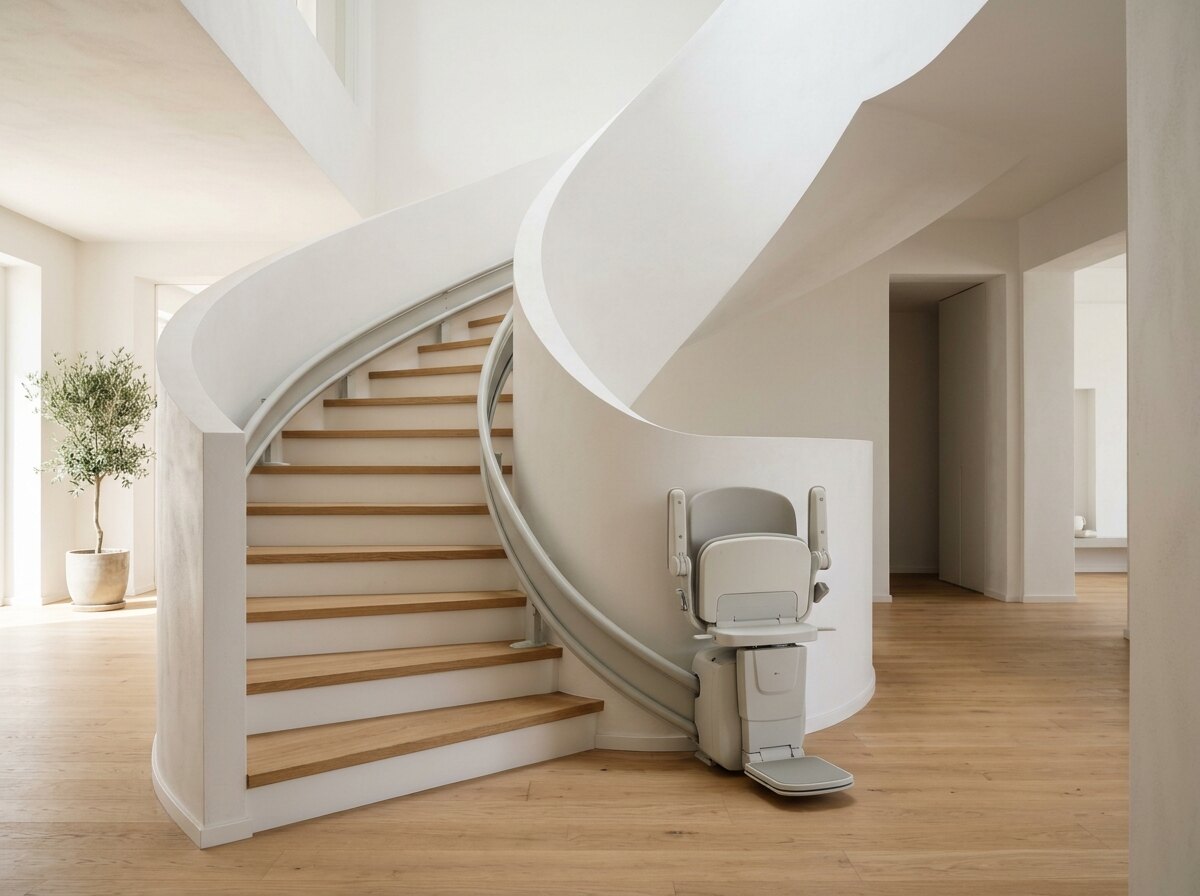
| Curves, landings or spiral | Curved-rail stair lift, made to measure | How long does manufacture take? How does the rail run at the landings? |
| Outdoor stairs | Outdoor stair lift or protected platform | What protection against water and sun? What IP code? Where is it parked? |
| Person who stays in the wheelchair, straight stairs | Inclined platform (EN 81-40) | Platform and wheelchair dimensions? Does it fold on the stairs? |
| Short level difference, with a wheelchair | Vertical platform (EN 81-41) or ramp | Pit depth? Headroom? Doors or barriers? |
| Several floors, wheelchair inside the home | Home lift with a cabin | Works and licence |
Each type in a few lines
Straight-rail stair lift. It follows stairs without curves and is usually the simplest case. Check the width left free for people walking up.
Curved-rail stair lift. The rail follows curves, landings or a spiral. A leaflet for a curved model, distributed in Portugal (file “Cadeira-elevatoria-curva-4000.pdf”, modified on 19 April 2024), states two rails, 136 kg standard load and 160 kg in the heavy-duty version, 125 mm minimum space for the rails, maximum slope of 56°, a chair that folds, seat belt, emergency button, sensors and a back-up battery. A brochure for another curved model (file “Handicare-Freecurve.pdf”, same date) says each guide is designed for the customer’s stairs. The leaflet does not state the minimum stair width. That is a question to ask.
Outdoor stair lift. The same leaflet states indoor and outdoor use, UV protection and a box rated IP44. Ask in writing what the manufacturer guarantees for your climate.
Inclined platform. It climbs the stairs with the person standing or in a wheelchair. The scope of EN 81-40 includes wheelchair platforms on stairs. For situations covered by the accessibility regime (Decreto-Lei n.º 163/2006), the annex requires a platform of at least 0.75 m by 1 m and, over stairs, one that folds to free the width of the stairs when not in use (section 2.7).
Vertical platform. It rises vertically between levels, without a completely enclosed cabin. By the scope of EN 81-41:2024, the slope does not exceed 15° from the vertical and the speed 0.15 m/s. A manufacturer’s page (Cibes, UK version) lists rated load, maximum travel, number of stops, pit depth or ramp and headroom. Ask for these data for your model.
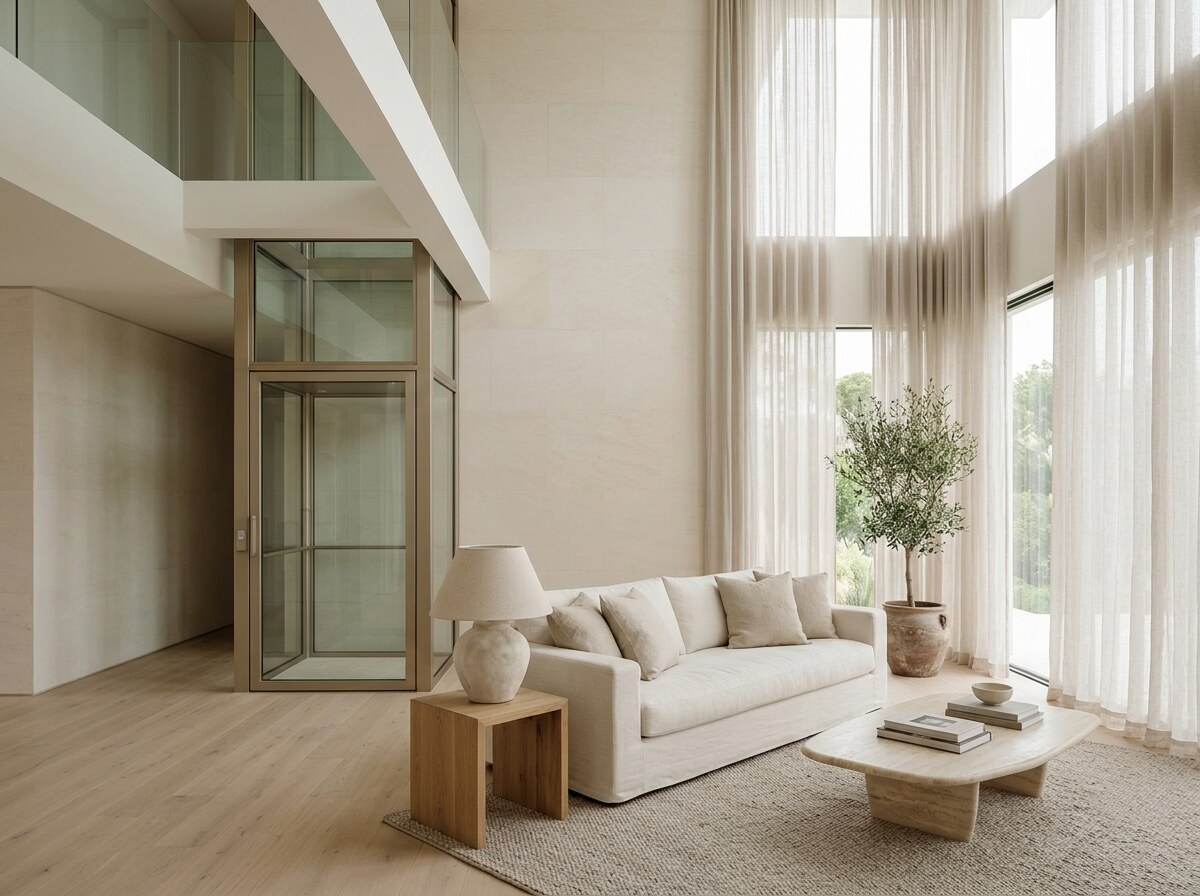
Lift with a cabin. If there is a closed cabin and several floors, a different regime applies. Directive 2014/33/EU applies to lifts with a car used permanently in buildings (Article 1(1)). Ask which directive and which standard the manufacturer declares.
CE marking and declaration of conformity
Before selling, the manufacturer must assess conformity, draw up the CE declaration and affix the “CE” marking (Directive 2006/42/EC, Article 5(1)). The declaration identifies the manufacturer, the machine (model and serial number) and, where they exist, the harmonised standards used (Annex II). Marking and declaration give a presumption of conformity (Article 7). In the European Commission list, EN 81-40:2020 appears since 15 October 2021 and EN 81-41:2024 since 14 August 2025.
Regulation (EU) 2023/1230 repeals the directive and applies from 20 January 2027 (Articles 51 and 54). The declaration becomes the “EU declaration of conformity” (Article 21). Products placed on the market before that date may continue to be made available (Article 52(1)). The manufacturer keeps the technical documentation and the declaration for ten years (Article 10(3)). Instructions must be in a language you understand, with a free printed copy if you ask at purchase (Article 10(7)).
CE marking is a declaration by the manufacturer and does not say the model suits your stairs.
The technical visit decides
Ask for the visit before choosing the type. The technician measures the stairs, sees who uses the equipment, where it is parked and where the socket is. Compare quotes on the same basis: how to compare quotes. For a first orientation, use the choice tool.
What we could not confirm
- The full text of EN 81-40 and EN 81-41 is paid. We read the scope on standards-body pages and the titles on the official list, without the required widths, loads or clearances.
- We found no official table linking stairs and person to a type. The table above is general guidance.
- We did not open a datasheet of a vertical platform sold in Portugal. The example is from a UK page.
- We could not confirm whether section 2.7 of Decreto-Lei n.º 163/2006 applies to a platform in an existing single-family house. Ask the câmara or the technician.
- We could not confirm the maintenance and inspection rules for this equipment.
Sources (read on 3 November 2026)
- Directive 2006/42/EC (Machinery): publications.europa.eu. Articles 5 and 7 and Annex II.
- Regulation (EU) 2023/1230, consolidated text: publications.europa.eu. Articles 10, 21, 51, 52 and 54.
- Directive 2014/33/EU (Lifts): publications.europa.eu. Article 1.
- European Commission, harmonised standards for the Machinery Directive, “SummaryListForLegislation_14.10.2025.pdf” (generated on 28 October 2026): single-market-economy.ec.europa.eu.
- EVS, EN 81-40:2020 (scope): evs.ee. EVS, EN 81-41:2024 (scope): evs.ee.
- Decreto-Lei n.º 163/2006, consolidated version in the Diário da República (last amendment 2024-01-08): diariodarepublica.pt. Article 2 and annex, section 2.7.
- Leaflet “Cadeira-elevatoria-curva-4000.pdf” and brochure “Handicare-Freecurve.pdf”, Medical Plus (both of 19 April 2024): medicalplus.pt.
- Cibes A5000, product page (NBS Source, UK): source.thenbs.com.
Questions and answers
EN 81-40:2020 covers chair, standing-platform and wheelchair-platform stair lifts (scope on the EVS page). Vertical platforms without a fully enclosed carrier follow EN 81-41:2024.
The manufacturer declares that the machine meets EU rules (Directive 2006/42/EC, Article 5). It does not say the model suits your stairs. Ask for the declaration of conformity with the serial number.
Yes. Regulation (EU) 2023/1230 repeals Directive 2006/42/EC and applies from 20 January 2027 (Articles 51 and 54). Products placed on the market before that date may stay on sale (Article 52).
The annex of Decreto-Lei n.º 163/2006 (section 2.7) asks for at least 0.75 m by 1 m and, over stairs, a folding platform. It applies to situations the decree covers. Confirm with the câmara or the technician whether it applies to your home.