In short
- Common stairs are common parts; new work is an innovation and normally needs a majority of owners representing two thirds of the building's value (art. 1425, para. 1).
- If someone in the owner's household has reduced mobility, art. 1425, para. 4 lets any owner fit platform lifts with prior notice to the administrator, without a vote.
- On that route whoever installs pays; other owners can join later by paying their share.
- Tenants need the landlord's written authorisation; always ask for the free width of the stairs because of the escape rules.
You live in a building under horizontal property (propriedade horizontal), with no lift, and someone at home can no longer climb the stairs. This guide explains what the Portuguese Civil Code says about putting a stair lift or a platform lift in the common stairs: when it is enough to notify the administrator, when a vote is needed, who pays, what changes for a tenant, and what fire safety rules mean for the stairs.
Updated on 3 November 2026. General information, not a substitute for the advice of a lawyer, the condominium administrator or a qualified technician.
The essentials
- Stairs and corridors in shared use are common parts of the building (Civil Code, art. 1421, para. 1, point c).
- As a general rule, new work in the common parts is an “innovation” and needs the approval of a majority of the owners, who must represent two thirds of the total value of the building (art. 1425, para. 1).
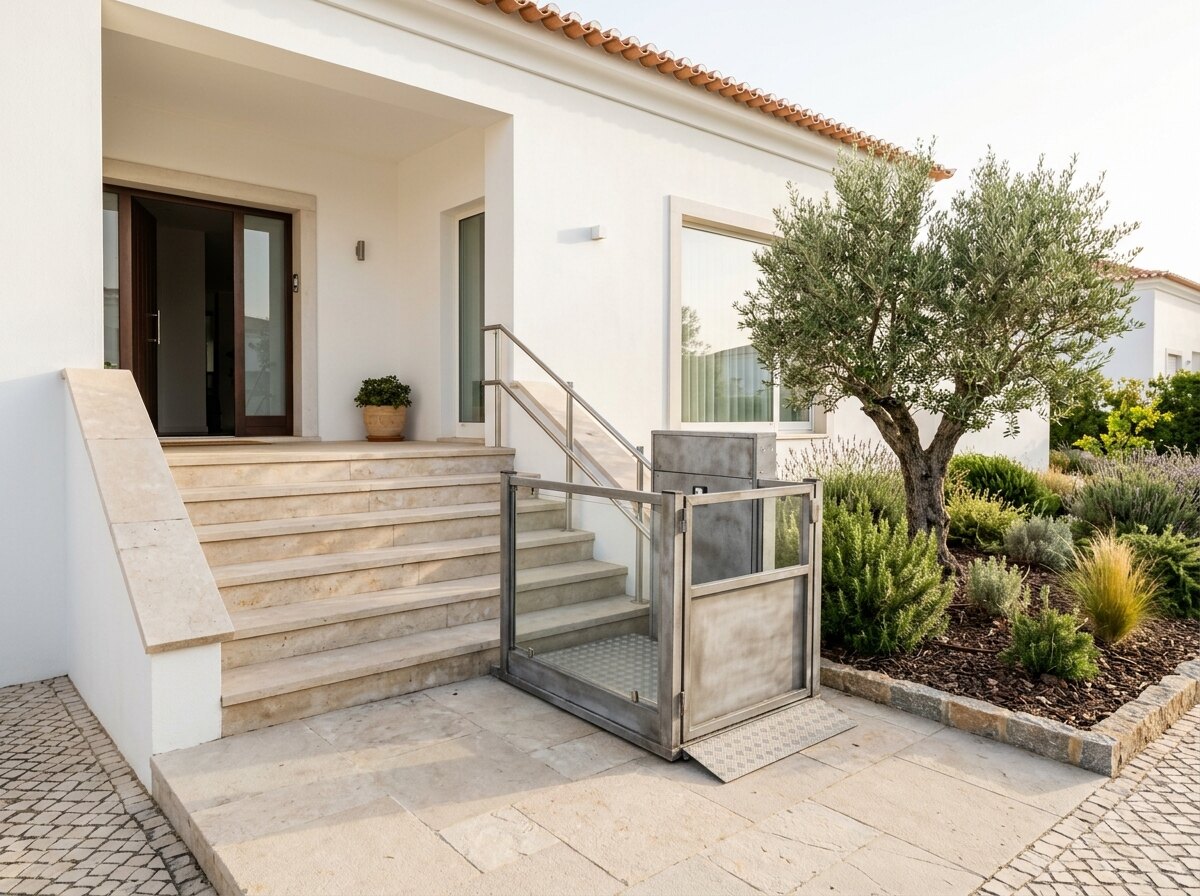
- There is a shorter route: if someone in the owner’s household has reduced mobility, any owner may fit ramps and platform lifts by notifying the administrator beforehand and following the technical accessibility standards; the article does not ask for a vote. It applies only if there is no lift that a person in a wheelchair can use (art. 1425, para. 4).
- On that route, whoever installs pays. The other owners can join later by paying their share (art. 1426, para. 5).
- The staircase is also an escape route: ask the installer, in writing, for the width that stays free.
Two routes to install in the common stairs
Route 1: a vote at the owners’ meeting. Art. 1425, para. 1 applies: a majority of owners representing two thirds of the total value of the building. Para. 2 lowers the bar to a majority of the value, but only for lifts (ascensores) and piped gas, in buildings with at least eight units. Platforms and stair lifts are not named there.
Route 2: notice to the administrator. When a member of the household is a person with reduced mobility, any owner may, “mediante prévia comunicação” (with prior notice) to the administrator and respecting the technical accessibility standards, fit access ramps and platform lifts, if there is no lift with a door and cabin that allow use in a wheelchair. The notice is given 15 days in advance (art. 1425, para. 7). We found no vote of the meeting there.
Points of attention:
- The law says “plataformas elevatórias” (platform lifts). It does not define the term or name the seated stair lift.
- Para. 8 forbids innovations that could harm any owner’s use of their own or the common parts. We saw nothing that sets it aside on route 2.
- “Reduced mobility” and the proof to give are not defined in that article.
Numbering: the rule comes from Lei n.º 32/2012 of 14 August, then as para. 3 (not from Lei n.º 8/2022, which changed other articles). Since 1 July 2026, Lei n.º 29/2026 added a para. 3 on energy self-consumption and the rule became para. 4. Arts. 1424, para. 5, and 1426, para. 5, still refer to “n.º 3 do artigo seguinte”; we understand them to mean the platforms, but that is our reading.
Who pays and who is responsible
- Route 2: only the owners who fitted the ramps and platforms share their costs (art. 1424, para. 5). Any owner may, at any time, take part by paying their share of installation and upkeep (art. 1426, para. 5).
- Removing the equipment: it may be removed by whoever installed it or paid a share, if this does not harm the building and they agree. If it cannot be removed, there is a right to its value under the rules on unjust enrichment (art. 1425, paras. 5 and 6).
- Route 1: the owners pay as set out in art. 1424. An owner who did not approve also pays, unless a court finds the refusal justified. A refusal is always justified if the work is purely decorative or out of proportion to the importance of the building (art. 1426, paras. 2 and 3).
- Fire safety: in residential buildings, keeping up the safety conditions in the common parts is the condominium’s responsibility (Decreto-Lei n.º 220/2008, art. 6, para. 3).
- Upkeep and insurance of the device: we found no specific rule. Agree them in writing.
An owner who disagrees with a decision has short deadlines (art. 1433): 10 days to ask for an extraordinary meeting and, to annul it in court, 20 days after that meeting or, if there was none, 60 days after the decision.
What if you are a tenant?
Art. 1425, para. 4 speaks of “any owner”, and a tenant is not an owner. Art. 1074, para. 2 says a tenant may carry out works only if the contract allows it or the landlord authorises it in writing. The exceptions in para. 3 are repairs the landlord fails to make (Civil Code art. 1036; Decreto-Lei n.º 157/2006, art. 22-A), not accessibility works.
We found no rule giving a tenant with reduced mobility the right to install a device without the landlord. The practical way is to ask for written authorisation, or for the landlord, as an owner, to use route 2. The text does not say whether the tenant’s household counts: get legal advice.
Fire safety and escape routes
The fire safety regime (Decreto-Lei n.º 220/2008) aims, among other things, to make evacuation easier (art. 4). It applies to works in existing buildings (art. 14-A), and only ANEPC or, in the 1st risk category, the municipality can waive provisions that are manifestly disproportionate.
In the Technical Regulation (Portaria n.º 1532/2008, text republished by Portaria n.º 135/2020) we read:
- the clear width of routes is measured from the floor, or from the steps, up to 2 m high (art. 56, para. 1);
- on routes serving housing only, the minimum is 0.90 m (1st risk category), 1.20 m (2nd) and 1.40 m (3rd and 4th) (art. 213);
- art. 65 covers escape stairs and mentions neither stair lifts nor platforms.
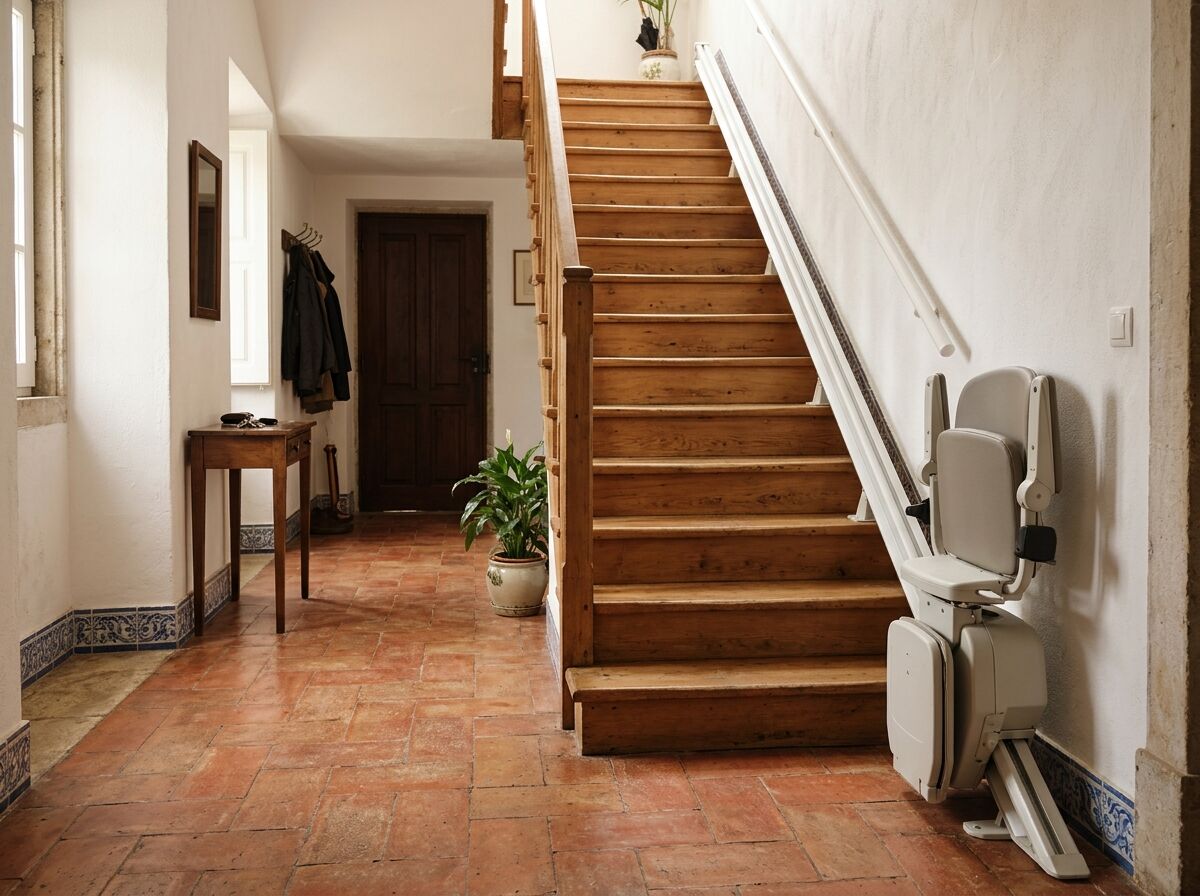
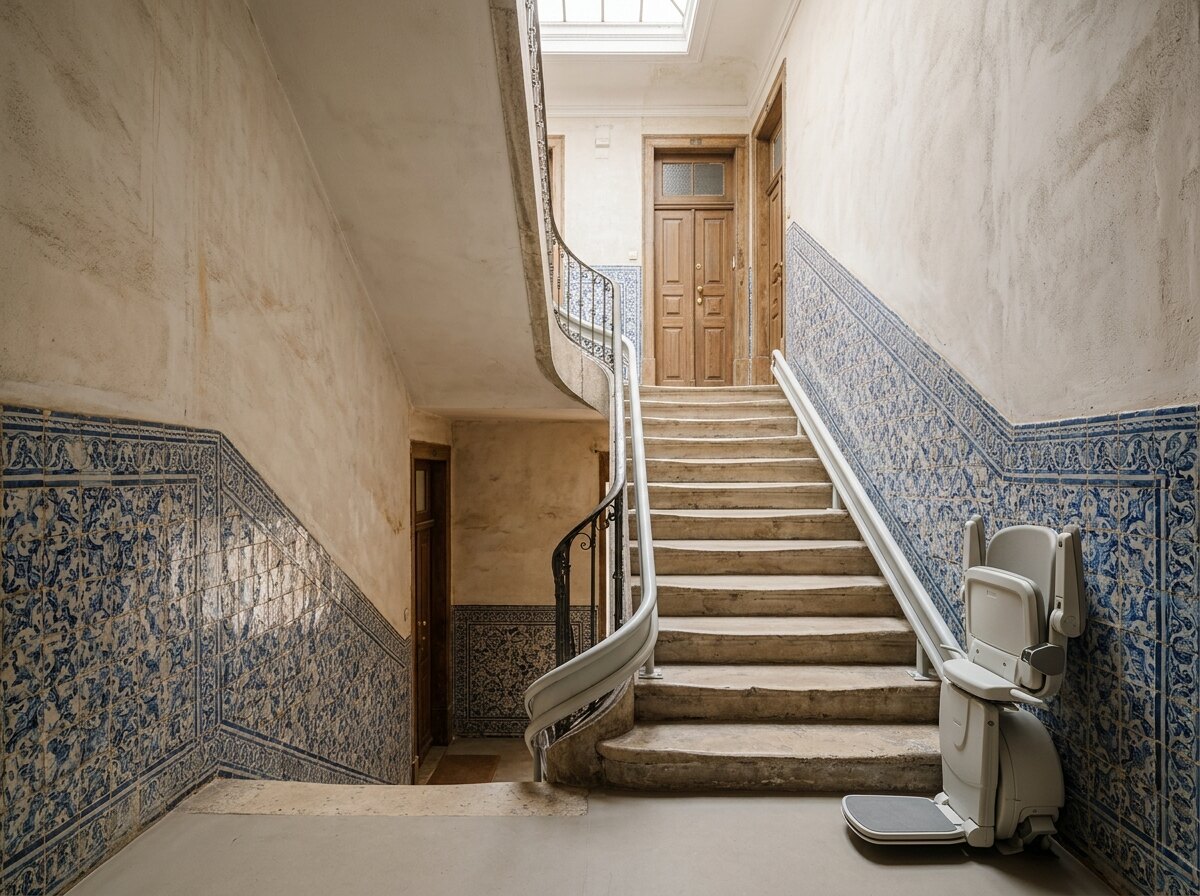
We found no express ban or permission. What counts is the width left with the equipment folded. Decreto-Lei n.º 163/2006 asks for platforms on stairs to be foldable, to free the width when not in use (annex, 2.7.6). Ask the installer for a statement of the free width and show it to the administrator, the building’s safety delegate and, in case of doubt, the municipality or ANEPC.
Step by step
- Read the condominium rules. They may have rules on works.
- Write to the administrator, explain the situation and ask who the safety delegate is.
- Ask for a technical visit and quotes that state the free width of the stairs with the device folded. See comparing stair lift quotes and stair lift or platform.
- Route 2: notify the administrator in writing, 15 days before. Route 1: ask for the item to go on the agenda. The notice goes by registered letter 10 days ahead and gives the day, time, place and agenda (art. 1432, paras. 1 and 4). Owners holding 25% of the capital can require the meeting to be called (art. 1431, para. 2).
- Ask the municipality whether the work needs any procedure.
On financial help, see who pays for a stair lift. To get started, use the tool to choose a solution.
What we could not confirm
- Whether a seated stair lift counts as a “plataforma elevatória” in art. 1425. No legal definition or court decisions read.
- How the majority at a second meeting is counted when two thirds are required.
- Whether the municipality requires a licence or notification (we did not read that regime).
- Whether maintenance and inspection is mandatory for these devices: the DGEG pages we read on lifting installations do not mention them.
- The Civil Code was read on the Procuradoria-Geral Distrital de Lisboa (PGDL) portal, which reproduces the Diário da República; the Diário’s own site did not open as text. Confirm art. 1425 in the Diário da República.
Sources (read on 3 November 2026)
- Civil Code, updated text (PGDL): arts. 1074, 1421, 1422, 1424, 1425, 1426, 1431, 1432, 1433; 90th version (Lei n.º 29/2026).
- Lei n.º 29/2026 of 23 June (PGDL): arts. 9 and 12.
- Lei n.º 32/2012 of 14 August, original version (PGDL): the 2012 wording of arts. 1425 and 1426.
- Decreto-Lei n.º 163/2006 (PGDL): preamble, arts. 2, 9, 9-A, annex (2.4, 2.7, 3.2); 6th version (Lei n.º 44/2026).
- Decreto-Lei n.º 157/2006 (PGDL): art. 22-A.
- Decreto-Lei n.º 220/2008 (PGDL): arts. 4, 5, 6, 14-A, 20.
- Portaria n.º 135/2020 of 2 June (Diário da República): arts. 56, 61, 64, 65, 213 of the republished regulation; read in a PDF copy.
- DGEG, Lifting installations: scope of maintenance and inspection.
Questions and answers
As a rule yes: Civil Code art. 1425, para. 1 asks for a majority of owners representing two thirds of the building's value. If someone in the household has reduced mobility, para. 4 allows platform lifts with prior notice to the administrator, without a vote. It is not clear whether a seated stair lift counts as a platform.
Only the owners who fitted the equipment share the costs (art. 1424, para. 5). Any owner can join later by paying their share (art. 1426, para. 5).
Civil Code art. 1074, para. 2 requires a contract that allows it or the landlord's written authorisation. We found no rule giving a tenant the right to do so without the landlord.
The fire safety regulation (Portaria n.º 1532/2008, art. 213) sets minimum widths of 0.90 m, 1.20 m or 1.40 m on escape routes of residential buildings, depending on the risk category. Ask the installer for the free width and consult the safety delegate, ANEPC or the municipality.