In short
- "For outdoor use" is not enough: ask in writing for the IP code, cover, temperature and battery of your model.
- The IP code has two digits (solids 0 to 6, liquids 0 to 9); the two data sheets we read differ (one IP44, one with no code).
- We found no guarantee against corrosion near the sea and no rule on equipment that projects over the footpath.
- The works law does not name the equipment; for a listed building or protection zone the regime is stricter.
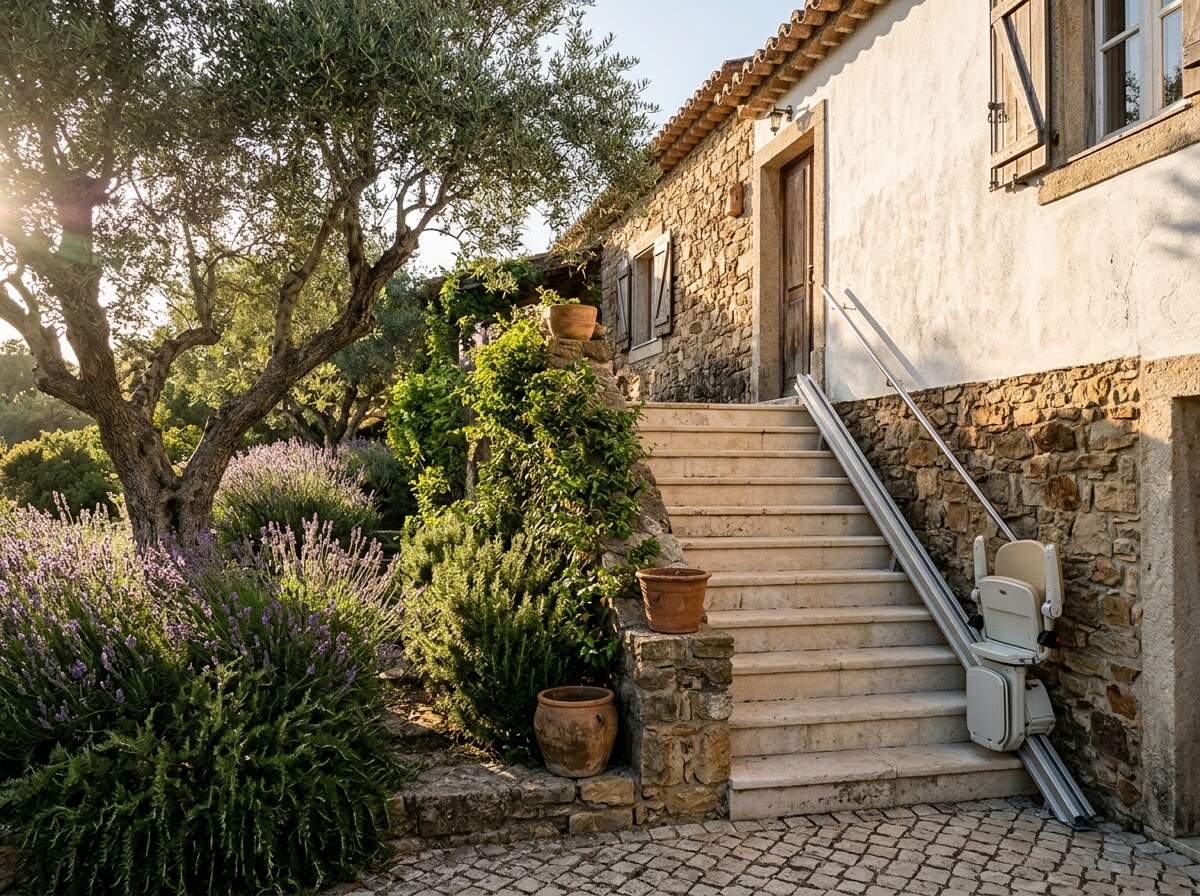
A stair lift on the front steps, the garden stairs or the terrace meets rain, sun, leaves and, near the sea, salty air. This guide shows what the IEC, two manufacturer data sheets and the law say about protecting the equipment and about the building work. It ends with questions for the installer.
Updated on 3 November 2026. General information; it does not replace a technician’s visit or the information from your town hall (câmara municipal).
The essentials
- “For outdoor use” does not say everything. Ask in writing, for your model, for the IP code, the cover, the temperature range and the battery. One data sheet we read states IP44; the other gives no IP code.
- The IP code has two digits: protection against solids (0 to 6) and against liquids (0 to 9), according to the IEC.
- We found no guarantee against corrosion near the sea in the data sheets. Ask.
- The building-works law does not name this equipment. For a listed building or one in a protection zone, the regime is stricter.
- If the stairs or the equipment take up the public footpath, talk to the town hall before you sign.
The IP code and the cover
On its page “Ingress Protection (IP) ratings”, the IEC explains that the IP code classifies how well an enclosure resists dust or liquids getting in. The first digit runs from 0 (no protection) to 6 (no ingress of dust); the second from 0 to 9 (high-pressure hot water). The tests are in IEC 60529, which is paid and which we did not read. So we do not explain what each middle number means.
Two data sheets read on 3 November 2026:
- Curved-rail chair (file “Cadeira-elevatoria-curva-4000.pdf”, Medical Plus, April 2024): “indoor and outdoor”, “improved UV protection and waterproof housing (IP44 rating)”. It does not say which parts carry the IP44.
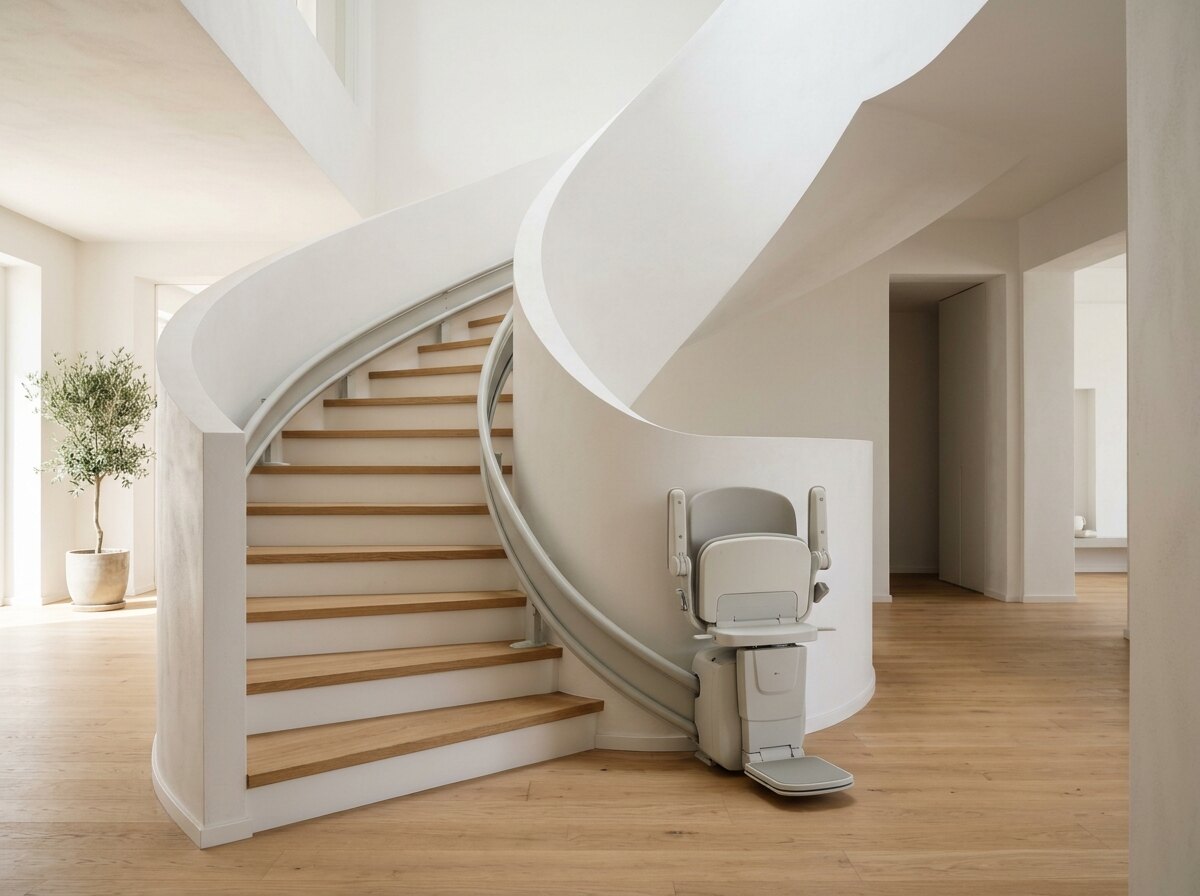
- Straight-rail outdoor chair (HomeGlide Outdoor, TK Elevator, file “access_homeglide_outdoor_brochure_en.pdf”, version EN_v1_05.2024): weatherproof coating on exposed parts against rain, dust and direct sunlight, and a full-length cover included. It gives no IP code.
Two “outdoor” data sheets say different things. Compare quotes on the same list: IP code and the parts it covers, cover included or optional, rail finish. The guide on comparing quotes shows how.
Heat, leaves and salt
- Temperature and battery. The HomeGlide sheet gives -15 °C to +50 °C, two 12 V 9 Ah batteries, and says it works during a power cut. That is the range of one model: ask for yours and ask where the battery is charged, which the sheet does not say.
- Leaves. Decree-Law 163/2006 (annex, section 4.13.3) says to avoid, next to accessible routes, plants that “shed many leaves, flowers, fruits or substances that make the floor slippery”. The rule is for another setting, but it points to the risk. Ask how the rail is cleaned.
- Salt. Neither sheet mentions corrosion or sea air. Near the sea, ask in writing for the material of the rail and fixings, the treatment of exposed parts and whether the warranty is valid in your area.
Steps, light, parking and cable
- Wet steps. The same decree asks, on stairs, for non-slip strips at least 0.04 m wide near the nosing (section 2.4.3) and handrails on both sides if the height difference exceeds 0.4 m (2.4.8). Confirm the equipment does not cover them. We did not confirm that these norms apply to the stairs of a private house.
- Light. We found no official lighting rule for outdoor stairs at a private home. Check whether the place is lit at night.
- Where it parks. The HomeGlide maker states 385 mm of projection with the chair folded and indoor handsets that send it to park at the top or bottom. Ask for the parking point on your landing and confirm there is free room to walk up. See how to measure the stairs.
- Power. Ask for the cable route drawn out and who makes the electrical connection. We did not read the rule for outdoor electrical installations.
Chair or platform outdoors
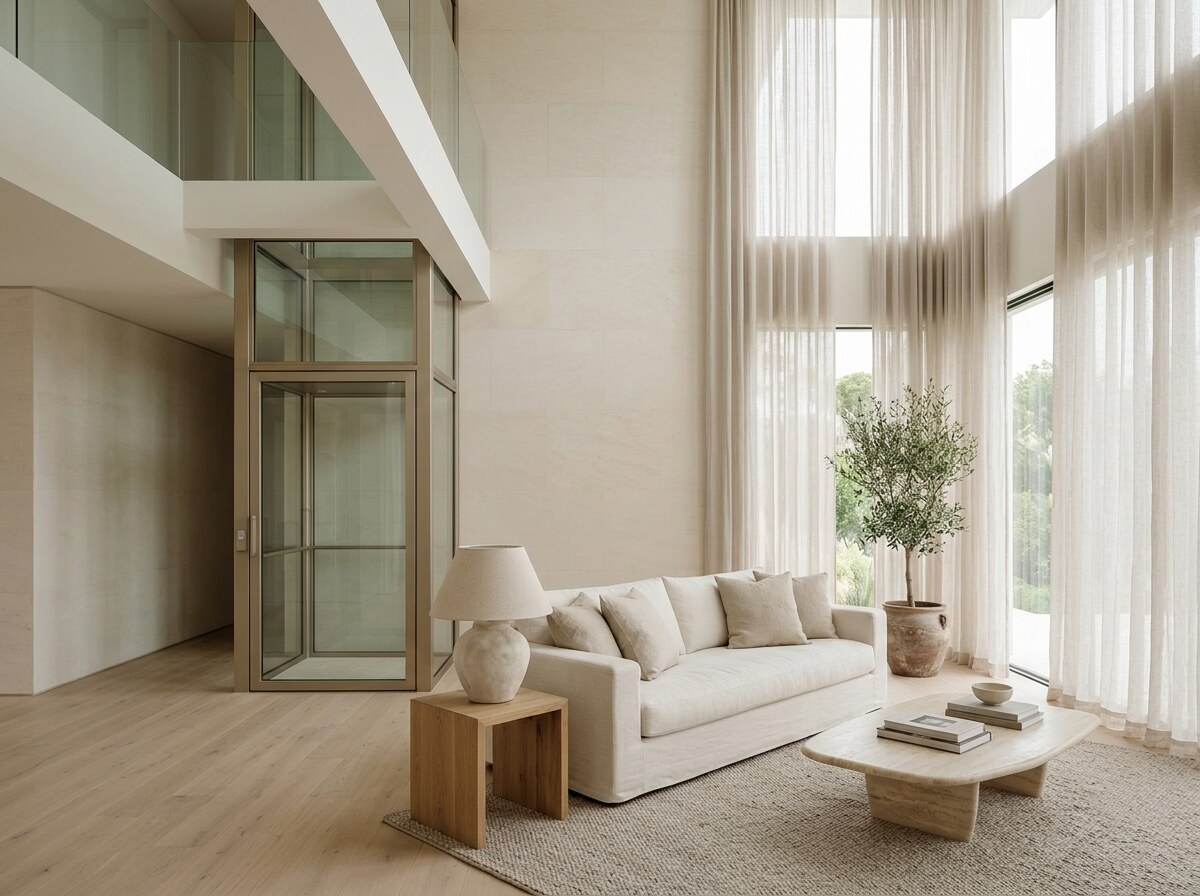
For someone who stays in a wheelchair, an open-air platform takes the rain on its floor. Decree-Law 163/2006 sets for lifting platforms at least 0.75 m by 1 m (2.7.1) and, over stairs, that they fold up (2.7.6). Ask how the floor drains water and whether it is non-slip. The comparison is in stair lift chair or platform; for a tower on the facade, see home lift in a house.
Works, footpath and protected zone
We read the RJUE (the urban development and building regime) as republished by Decree-Law 108/2026 of 29 May.
- Equipment not named. Maintenance works and works of minor urban relevance are exempt from licence and prior notice (article 6), which includes “small works to tidy and improve the area around buildings that do not affect public domain” (article 6-A, no. 1, point d). We found no text saying whether a chair on outdoor stairs fits here. A municipal regulation may add cases. Ask the town hall.
- Listed building or protection zone. Article 6-A, no. 2, excludes them from minor works, and article 4, no. 2, point d), requires a licence for “exterior alteration”, with exceptions.
- Heritage opinion. Law 107/2001 (article 43) gives listed buildings a general protection zone of 50 m. There, works that alter, in general, volumes, roofs or exterior cladding cannot be licensed without a favourable opinion from the heritage administration; interior works are left out.
- Footpath. If a licence is needed, the request to occupy the public road can go in the same application (article 4, nos. 7 and 8). We found no rule on equipment that projects over a footpath.
- Accessibility. Decree-Law 163/2006 applies the technical norms to residential buildings (article 2, no. 3). For existing ones it refers to a method to be set by ministerial order, with the designer’s justification (article 9-A), and allows exceptions when the works noticeably affect cultural heritage (article 10, no. 1). For VAT, see VAT and income tax.
Questions for the installer
- What is the IP code, which parts does it cover, and can I see the dated data sheet?
- Is the cover included? What finish do the rail and fixings have?
- What is the temperature range and where is the battery charged?
- Where does the chair park and who runs the electric cable?
- How and when are the rail cleaned and serviced? Does the warranty cover my area?
- Who deals with the town hall, if needed, and what happens if the building is listed?
For a first orientation, use the selection tool.
What we could not confirm
- The text of IEC 60529 and the IP code of the HomeGlide Outdoor.
- Which parts carry the IP44 on the curved-chair sheet.
- Any data on corrosion from sea air.
- Whether the works law exempts a chair on outdoor stairs and whether Decree-Law 163/2006 applies to an existing house. We did not read the ministerial order of article 9-A.
- A municipal rule on equipment that projects over the footpath.
- The consolidated text of article 43 of Law 107/2001; we read the 2001 original.
- Outdoor electrical safety, lighting and prices.
Sources (read on 3 November 2026)
- IEC, “Ingress Protection (IP) ratings”: https://www.iec.ch/ip-ratings. IEC 60529, standard page (edition 2.2, 2013): https://webstore.iec.ch/en/publication/2452
- Medical Plus, “Cadeira-elevatoria-curva-4000.pdf” (April 2024): https://www.medicalplus.pt/wp-content/uploads/2024/04/Cadeira-elevatoria-curva-4000.pdf
- TK Elevator, “access_homeglide_outdoor_brochure_en.pdf” (EN_v1_05.2024): https://www.tkelevator.com/media/turkey_1/brochures_8/access_homeglide_outdoor_brochure_en.pdf
- Decree-Law 163/2006, consolidated version (last amendment 2024-01-08): https://diariodarepublica.pt/dr/legislacao-consolidada/decreto-lei/2006-108253479. Articles 2, 9-A, 10; annex, sections 2.4, 2.7, 4.13.
- Decree-Law 108/2026, RJUE republished (articles 4, 6, 6-A), copy: https://ordemdosarquitectos.org/backend/uploads/DL_N_108_2026_29_MAIO_2786145a69.pdf
- Law 107/2001, article 43, original text: https://diariodarepublica.pt/dr/detalhe/lei/107-2001-629790
Questions and answers
The IP code has two digits: the first runs 0 to 6 (solids), the second 0 to 9 (liquids), according to the IEC. We did not read IEC 60529, so ask the maker what the 4 guarantees and which parts it covers.
We found no text that says so. The RJUE exempts maintenance and minor works (articles 6 and 6-A) but does not name this equipment. Ask the town hall.
RJUE article 4, no. 2, point d), requires a licence for exterior alteration, and article 43 of Law 107/2001 requires a favourable heritage opinion. Confirm with the town hall or the DGPC.
The two data sheets we read have no data on corrosion or sea air. Ask in writing for the material of the rail and fixings and whether the warranty is valid in your area.