In short
- Stair lift chair, lifting platform and home lift are three different kinds of equipment; the quote should say which one it is.
- Rail, carriage and flight are trade words with no official definition: ask what each one includes.
- Ask for the CE marking and the declaration of conformity, with the serial number of your unit.
- The legal guarantee is three years from delivery (Decreto-Lei n.º 84/2021, article 12, paragraph 1).
A stair lift quote is full of words nobody explains: rail, carriage, flight, declaration of conformity. This glossary says what each one means, in plain words, so you can read the quote before you sign. Where the meaning comes from the law we give the article; where it is common trade usage we say so.
Updated on 3 November 2026. General information; it does not replace the opinion of a technician, a lawyer or the explanation of the company that makes the quote.
The essentials
- Three kinds of equipment, three names: stair lift chair (a seat), lifting platform (standing or in a wheelchair) and home lift (usually with a cabin). The quote should say which one it is.
- Trade words (rail, carriage, flight) have no official definition and vary between manufacturers. Ask what each one includes.
- Ask for the CE marking and the declaration of conformity of the model, with the serial number of your unit.
- The legal guarantee is three years from delivery (Decreto-Lei n.º 84/2021, article 12, paragraph 1).
- In an apartment building, “innovation” and “horizontal property” are terms of the law and decide who has to approve the work.
Equipment
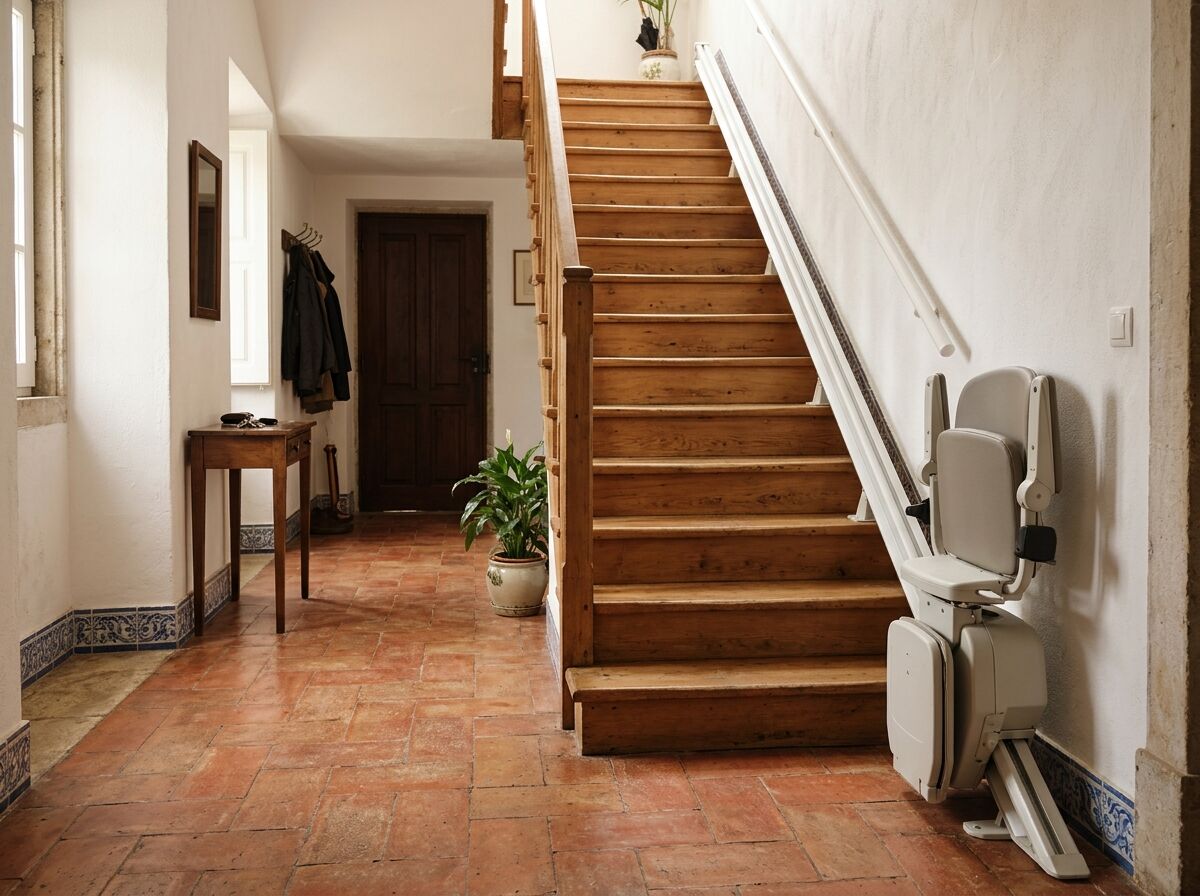
- Straight stair lift chair. A seat that goes up and down on a straight rail, with no bends. Common usage; also called an “elevador de escadas”.
- Curved stair lift chair. The rail follows bends or landings, so it is made to measure after the stairs are measured. Ask whether making the rail is in the price.
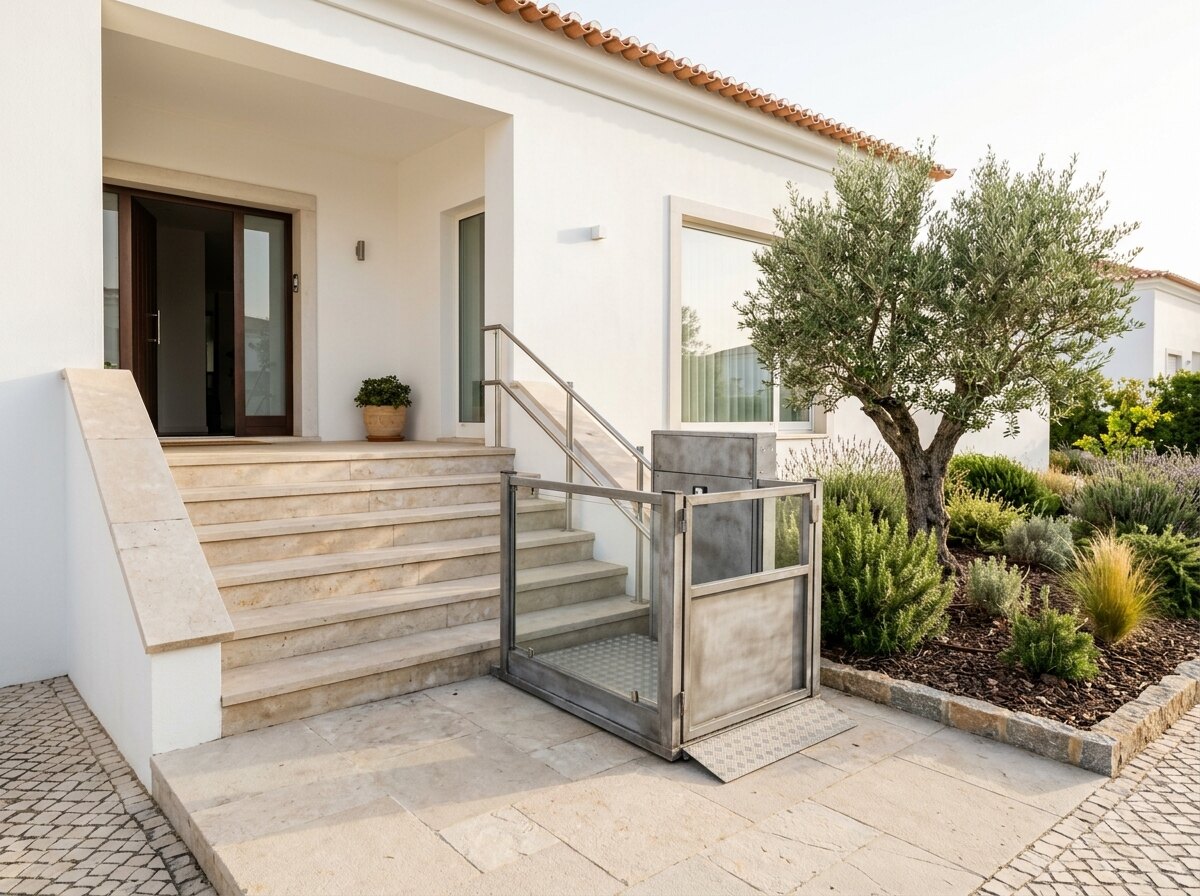
- Lifting platform. Instead of a seat, a platform where the person stands or sits in a wheelchair. The annex to Decreto-Lei n.º 163/2006 (section 2.7) has rules for them. See chair or platform.
- Home lift or “homelift”. Usually has a closed cabin and links floors. It is a bigger job than a chair; see the home lift in a house.
Parts of the unit
Common-usage names that change from brand to brand. We read manufacturers’ leaflets only to see which words they use.
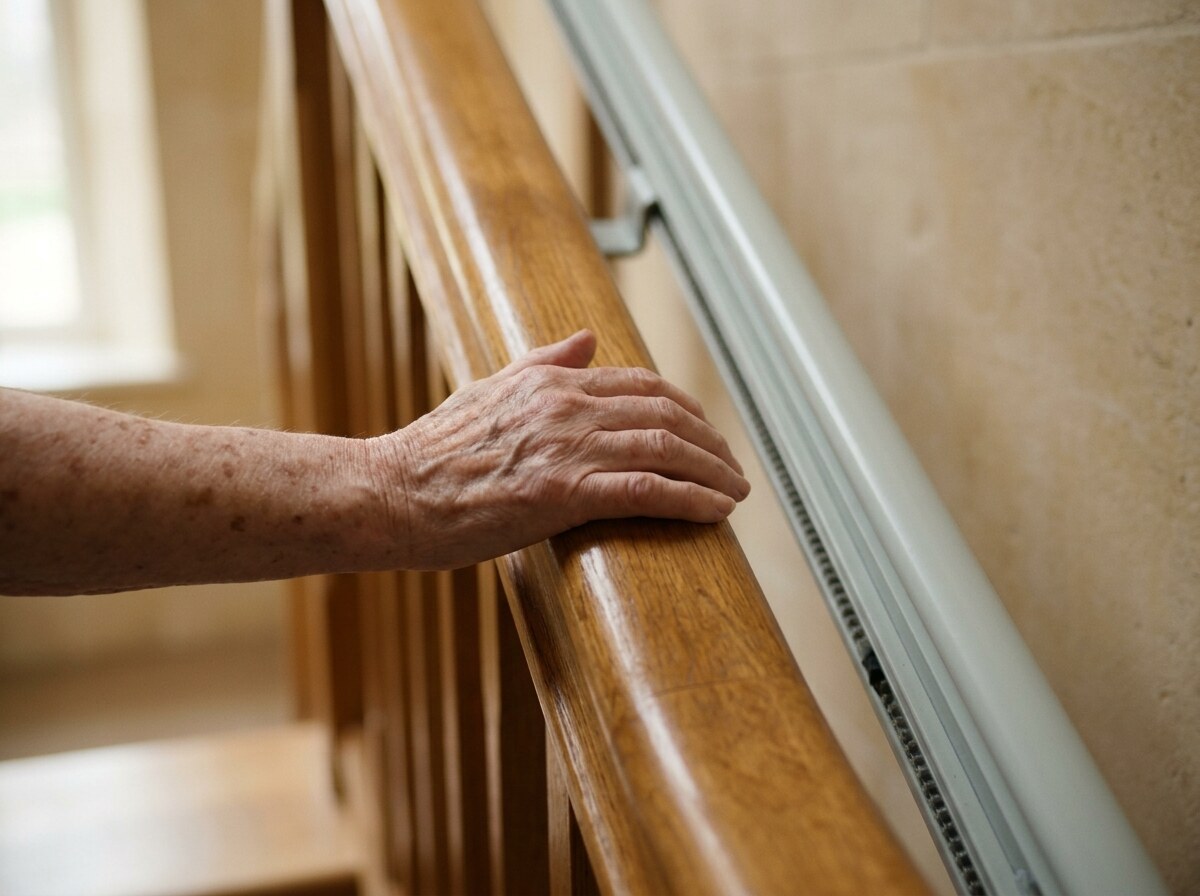
- Rail (or track). The guide fixed to the stairs along which the unit travels. Ask where it is fixed.
- Carriage. The motorised part that travels on the rail and carries the seat or the platform.
- Seat and footrest. The seat has arms; the footrest is below. Ask for the sizes open and folded.
- Folding rail or seat. Folds to leave room on the stairs when nobody is using it. One leaflet speaks of a “guia rebatível”; quotes say “rail dobrável”.
- Seat swivel. Turning the seat at the end of the run, to step off facing the floor without stepping onto the stairs. Some models turn by themselves, others by hand.
- Control. Buttons on the arm of the seat and sometimes call controls on each floor. “Constant pressure” means, in common usage, that the unit moves only while the button is held down.
- Battery and charger. One leaflet mentions a back-up battery for power cuts. Ask where the charger is.
- Landing, flight and step. A step is each tread; a flight is the run of stairs between two landings; a landing is the flat area where the stairs change direction or floor. See how to measure the stairs.
- Usable stair width. The free width left to walk through. Ask in writing for the width left after installation, with the unit folded.
Safety and conformity
- Seat belt and safety sensors. Leaflets speak of a retractable belt, an emergency button and sensors that stop the unit if there is an obstacle in the way.
- Maximum weight. The load the model accepts. Give the person’s real weight; one leaflet has versions with different loads.
- CE marking. For machines, the manufacturer applies it before putting the unit on the market (Directive 2006/42/EC, article 5, paragraph 1, point f). It is the manufacturer’s statement and does not prove the model suits your stairs.
- Declaration of conformity. A document from the manufacturer that must accompany the unit (same directive, article 5, paragraph 1, point e). In January 2027 the directive is repealed by Regulation (EU) 2023/1230, and it becomes the “EU declaration of conformity” (articles 21 and 51).
- Escape route (“via de evacuação”). A horizontal or vertical link in a building with safe conditions for occupants to leave; vertical ones can be stairs (Portaria n.º 1532/2008, republished by Portaria n.º 135/2020, article 4, point 14). Ask the installer for the width that remains.
Contracts and guarantee
- Technical visit. The visit where the company measures the stairs and sees the place. Use it to compare quotes.
- Legal guarantee. The trader is liable for a lack of conformity that appears within three years of delivery (article 12, paragraph 1). If the contract includes installation, there is delivery only when installation is finished (article 11, paragraph 2). The consumer can ask for repair or replacement, a price reduction or termination of the contract (article 15, paragraph 1).
- Maintenance contract. A separate agreement, with periodic servicing. It does not come from the legal guarantee: the price and the number of visits are those of the contract. Ask for it in writing.
Support and apartment buildings
- Technical aid (“ajuda técnica”, assistive product). The law says “produtos de apoio”, formerly “ajudas técnicas”: equipment used by a person with a disability to prevent or compensate a limitation (Decreto-Lei n.º 93/2009, article 4, point c).
- SAPA. The assistive products allocation system, created by that decree-law. The 2025 list (Despacho n.º 11077/2025) includes stair lifts with a seat and with a platform, with the Social Security Institute as funder and prescription by a multidisciplinary team. See who pays and VAT and income tax.
- Reduced mobility (“mobilidade condicionada”). The preamble of Decreto-Lei n.º 163/2006 includes people in wheelchairs, people unable to walk or unable to cover long distances, and the temporarily restricted, such as pregnant women, children and older people.
- Horizontal property (“propriedade horizontal”). The units of a building, being independent, can belong to different owners (Civil Code, article 1414). Stairs in shared use are common parts (article 1421, paragraph 1, point c).
- Innovation (“inovação”). Article 1425 does not define it: it says innovations need the majority of owners, representing two thirds of the value of the building (paragraph 1). If someone in the household has reduced mobility and there is no lift a wheelchair user can use, an owner can fit lifting platforms after notifying the administrator (paragraph 4). See the apartment building guide. To choose, use the tool.
What we could not confirm
- Official definitions of rail, carriage, flight, swivel and usable width: we found none. We describe them by common usage and from undated leaflets.
- Whether a stair lift chair counts as a “lifting platform” in article 1425: the law does not define it and we read no decisions.
- “Reduced mobility” is described only in the preamble; we do not know how it applies to a concrete case.
- The exact date from which Regulation (EU) 2023/1230 applies: we give only “January 2027”.
Sources (read on 3 November 2026)
- Decreto-Lei n.º 163/2006, updated version (6th, Lei n.º 44/2026): preamble, article 2, annex (2.7). https://www.pgdlisboa.pt/leis/lei_mostra_articulado.php?nid=3110&tabela=leis
- Civil Code, updated version (90th, Lei n.º 29/2026): articles 1414, 1415, 1421, 1425. https://www.pgdlisboa.pt/leis/lei_mostra_articulado.php?nid=775&tabela=leis
- Decreto-Lei n.º 84/2021 (DR, 1st series, no. 202): articles 11, 12, 15. https://files.dre.pt/1s/2021/10/20200/0000400029.pdf
- Decreto-Lei n.º 93/2009, original text (DR, 1st series, no. 74): article 4. https://files.diariodarepublica.pt/1s/2009/04/07400/0227502277.pdf
- INR, Despacho n.º 11077/2025, Annex I (18 30 10 and 18 30 11). https://files.diariodarepublica.pt/2s/2025/09/181000000/0008700121.pdf
- Directive 2006/42/EC, article 5; Regulation (EU) 2023/1230, articles 21, 51 and 54 (publications.europa.eu).
- Portaria n.º 135/2020: https://diariodarepublica.pt/dr/detalhe/portaria/135-2020-134991810
- Manufacturers’ leaflets (vocabulary, undated): Salvatec, LiftBoy, Handicare.
Questions and answers
The chair has a seat; the platform carries the person standing or in a wheelchair. The annex to Decreto-Lei n.º 163/2006 (section 2.7) has rules for lifting platforms. The quote should say which one it is.
It is the manufacturer's document that must accompany the machine (Directive 2006/42/EC, article 5, paragraph 1, point e). Ask for a copy with the model and serial number of your unit.
Three years from delivery; if the seller installs it, delivery counts when installation is finished (Decreto-Lei n.º 84/2021, articles 11 and 12).
Article 1425 of the Civil Code does not define it; it says innovations need the majority of owners, with two thirds of the building's value. There is a separate route for lifting platforms by notifying the administrator (paragraph 4).